Flannery O’Connor was born in Savannah, Georgia in 1925, the only child of Catholic parents. In 1945 she enrolled at the Georgia State College for Women. After earning her degree she continued her studies on the University of Iowa’s writing program, and her first published story, ‘The Geranium’, was written while she was still a student. Her writing is best-known for its explorations of religious themes and southern racial issues, and for combining the comic with the tragic. In 1952 she learned that she was dying of lupus, a disease which had afflicted her father. For the rest of her life, she lived with her mother on the family dairy farm, Andalusia, outside Millidgeville, Georgia. For pleasure she raised peacocks, pheasants, swans, geese, chickens and Muscovy ducks.

She was a good amateur painter. She died in the summer of 1964.
With the surprising commercial success of Lamb in His Bosom, Caroline “Carrie” Miller became the first Georgian to win a prestigious Pulitzer Prize for a novel, and she was honored as well with the prestigious French Prix Femina. Lamb would go through more than thirty printings in its first edition, and there would be translations into several languages. Ironically, the eclipse of Miller’s celebrity was hastened by Lamb in his Bosom’s commercial success, which prompted a Macmillan editor to go talent scouting for novelists in Georgia, where he would meet young woman named Margaret Mitchell, who had a manuscript of her own.
Margaret Mitchell was an American novelist. After a broken ankle immobilized her in 1926, Mitchell started writing a novel that would become Gone With the Wind. Published in 1936, Gone With the Wind made Mitchell an instant celebrity and earned her the Pulitzer Prize. The film version, also lauded far and wide, came out just three years later. More than 30 million copies of Mitchell’s Civil War-era book have been sold worldwide, and it has been translated into 27 languages. Mitchell was struck by a car and died in 1949, leaving behind Gone With the Wind as her only novel.


Joel Chandler Harris (December 9, 1848 – July 3, 1908) was a journalist, fiction writer, and folklorist best known for his collection of Uncle Remus stories. Born in Eatonton, Georgia, at the age of 14, Harris quit school to work on Turnwold Plantation nine miles east of Eatonton.
While at Turnwold Plantation, Harris spent hundreds of hours in the slave quarters during time off. He was less self-conscious there and felt his humble background as an illegitimate, red-headed son of an Irish immigrant helped foster an intimate connection with the slaves. The African-American animal tales they shared later became the foundation and inspiration for Harris’s Uncle Remus tales. On July 20, 1879, Harris published “The Story of Mr. Rabbit and Mr. Fox as Told by Uncle Remus” in The Atlanta Constitution. The stories, were mostly collected directly from the African-American oral storytelling tradition.
As a journalist at The Atlanta Constitution Harris supported a vision of the New South with editor Henry W. Grady (1880–1889), which stressed racial reconciliation in the South.


Alice Walker was born in 1944 in rural Georgia, the youngest child of a sharecropper. When she was eight years old, while playing with two of her older brothers, a copper B.B. pellet hit her in the eye. The accident was traumatic, and Alice changed from being a brassy, self-confident child, interested in doing grown-up things, into a shy, solemn, and solitary girl.
Walker immersed herself in her studies, was consistently excellent in them, and after graduation won a scholarship to Spelman College, a small prestigious black women’s school in Atlanta, Georgia. After two years, Walker left to attend Sarah Lawrence College in Bronxville, New York. There she majored in literature and studied extensively in Latin poetry and history.
Her first novel, published in 1970, was The Third Life of Grange Copeland. During this time, Walker also held an editorial position at Ms. magazine; Gloria Steinem, editor-in-chief at Ms., was extremely encouraging and supportive of Walker’s efforts, ideas, and writing. In 1976, Meridian, Walker’s second novel, the story of a woman fighting for civil rights in the American South, was published. In 1982, Walker received the Pulitzer Prize for Literature for her third novel, The Color Purple.


Born September 5, 1916, to Rufus Garvin and Wilhelmina Yerby, Frank Yerby’s early life was marked by racial conflict, a thread that would run through his fiction. Though he identified as black, Yerby’s parents were a racially mixed couple, and the young Yerby had to fight for acceptance from blacks as well as whites.
Augusta, Georgia, native Frank Yerby lived his life and his literary career struggling with racism and became an internationally best-selling author of historical fiction, but the isolation he encountered in his native country forced him to conclude his remarkable career as an American exile in Spain.
Terry Kay followed an Atlanta newspaper career with a novelist’s success story, drawing inspiration from his memories of life in rural north Georgia. Kay’s career as a novelist began with The Year the Lights Came On, published in 1976. Kay’s novel explores life in rural Georgia in the era when rural areas were receiving electrical power for the first time. Terry Kay’s most celebrated work is To Dance with the White Dog, which was published in 1990.The work made him internationally famous. The Hallmark Hall of Fame dramatization of the novel in 1993 won an Emmy. The novel began as a nonfiction work to celebrate Kay’s parents’ long marriage and to recount how his father, who died of cancer in 1980, was visited by a white dog after his wife’s death in 1973.


Terrell (Terry) Jenkins, known by the pen name of Lynn Terrell, is a southern author of espionage and mystery novels. A native of Savannah, Georgia, he grew up during the tumultuous 1940s and 1950s, which he describes as one of the most compelling periods in the nation’s history. Following military service, he earned journalism degrees from Kent State and Northwestern Universities and worked briefly for newspapers before moving to speech writing. He credits his affinity for writing to his mother, who composed song lyrics and poetry. In addition to penning his three novels, A Gathering Storm, The Descendant and Bless Me Father, as a talented visual artist, videographer and lyricist Terry’s work appears in the Medal of Honor Museum and musical promotions for Savannah.


Rosemary Daniell is the founder and leader of Zona Rosa, a series of life-changing writing workshops with events in Atlanta, Savannah, and Europe. She is also the award-winning author of eight books of poetry and prose, including Secrets of the Zona Rosa: How Writing (and Sisterhood) Can Change Women’s Lives and The Woman Who Spilled Words All Over Herself: Writing and Living the Zona Rosa Way, and is the recipient of two National Endowment for the Arts fellowships in writing, one in poetry, another in fiction. Rosemary’s work has been featured in many magazines and papers, including Harper’s Bazaar, New York Woman, Travel & Leisure, The New York Times Book Review, Newsday, The Chicago Tribune, The Philadelphia Inquirer and Mother Jones; she has also been a guest on many national radio and television shows, such as “The Merve Griffin Show,” “Donahue,” “The Diane Rehm Show,” “Larry King Live” and CNN’s “Portrait of America.” Early in her career, she instigated and led writing workshops in women’s prisons. She is profiled in the book Feminists Who Changed America.


Erskine Caldwell was born Dec. 17, 1903, in Moreland, Ga., and moved with his parents from one place to another in the Carolinas, Virginia, Florida, Tennessee and back to Georgia. Following high school, Caldwell attended Erskine College, in South Carolina, and the University of Virginia, among other institutions. He never received a degree, but at the University of Virginia a professor encouraged him to be a writer. Caldwell was one of the most successful writers in history. His books have sold more than 80 million copies worldwide and have been translated into more than 40 languages. “God’s Little Acre,” banned in Boston and reviled by many after it was published in 1933, was at one time the champion best-seller with more than 10 million copies.
Success came slowly for Caldwell–first with an occasional story published in one of the small magazines that paid little or nothing. Then he sold a novelette, “The Bastard.” Maxwell Perkins, the famed Charles Scribner’s Sons editor, spotted his stories and published a collection of them under the title “American Earth.”
With the little money he made from that, Caldwell took off by himself around the country with his portable typewriter and his cigarette-rolling machine, living in a cheap Hollywood hotel room for a while, returning to Wrens, Ga., and finally going to New York where he turned out “Tobacco Road.”
His fame and his financial security were assured. The royalties from the stage play alone were enough to keep him comfortable for many years. Then came “God’s Little Acre,” the runaway best-seller. Its profanity and sexually explicit passages brought not only a ban in Massachusetts but his home state Georgia Literary Commission recommended jail for anyone caught reading it.
A New York magistrate, however, ruled that the novel was, indeed, literature.
Caldwell worked for a time as a screenwriter for Metro-Goldwyn-Mayer, but his two big assignments were to write short features in a series called “Crime Does Not Pay” and to co-author a logging camp script for Clark Gable. It was never produced. Caldwell died in 1987 at 83 years of age of lung cancer.
Lillian Smith was born on December 12, 1897, to a prominent family in Jasper, Florida, the seventh of nine children. Her life as the daughter of a middle-class civic and business leader took an abrupt turn in 1915 when her father lost his turpentine mills. The family was not without resources, however, and decided to relocate to their summer residence in the mountains of Clayton, Georgia, where her father had previously purchased property and operated the Laurel Falls Camp for Girls.
She spent a year studying at Piedmont College in Demorest, Georgia, (1915–16). She returned home and helped her parents manage a hotel and taught in two mountain schools before accepting a position to be director of music at a Methodist school for girls in China. She was not a churchgoer and did not consider herself religious, however this time abroad gave way for a pivotal moment in Smith’s awareness of the Southern double standard. She studied Chinese philosophy during her time overseas and by living in China was exposed to the similarities between the suppression of the Chinese and African Americans in the States.
Her time in China was limited, however, by her father’s declining health, so she was forced to return home to the States in 1925. Back in Georgia, she assumed the role of heading the Laurel Falls Camp, a position she would hold for the next 23 years (1925–48). Laurel Falls Camp soon became very popular under her direction as an innovative educational institution known for its instruction in the arts, music, drama, and modern psychology. Her father died in 1930, and she was left with responsibility for the family business and the care of her ill mother.


‘Miss Lil’s Camp’ is a documentary film about the director of an exclusive summer camp for girls from upper middle class Southern homes. Miss Lil, as Lillian Smith was known, taught Laurel Falls’ campers that segregation was wrong and interracial love relationships permissible. She expressed her thoughts and radical ideas at a time when Southern leadership was committed to a racially segregated society and Jim Crow laws permeated every aspect of social life. Some young campers were repulsed by her ideas while others embraced them. In short, Lillian Smith was no ordinary woman and Laurel Falls no ordinary camp.
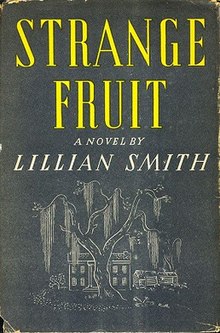
Strange Fruit is a 1944 bestselling novel debut by Lillian Smith that deals with the then-forbidden and controversial theme of interracial romance. Originally using the working title Jordan is so Chilly, Smith later changed the title to Strange Fruit prior to its publication. In her autobiography, singer Billie Holiday wrote that Smith chose to name the book after her song “Strange Fruit”, which was about the lynching and racism against African Americans. Smith maintained the book’s title referred to the “damaged, twisted people (both black and white) who are the products or results of our racist culture.
After the book’s release, the book was banned in Boston and Detroit for “lewdness” and crude language. Strange Fruit was also banned from being mailed through the U.S. Postal Service until President Franklin D. Roosevelt interceded at his wife Eleanor’s request.

Lillian Smith battled breast cancer from the early 1950s on and died on September 28, 1966, at the age of 68. Her book The Journey (1954) details some of this battle. She is buried near the old theater chimney, Laurel Falls camp atop Screamer Mountain, Clayton, Georgia.
Carson McCullers was an American novelist, short story writer, playwright, essayist, and poet. Her first novel, The Heart Is a Lonely Hunter, explores the spiritual isolation of misfits and outcasts in a small town of the Southern United States. Her other novels have similar themes and most are set in the deep South.
With influences such as Isak Dinesen, Dostoevsky, Chekhov, and Tolstoy she published eight books; the best known are The Heart Is a Lonely Hunter (1940), Reflections in a Golden Eye (1941) and The Member of the Wedding (1946). The novella The Ballad of the Sad Cafe (1951) depicts loneliness and the pain of unrequited love; at the time of its writing, McCullers was a resident at Yaddo, the artists’ colony in Saratoga, New York.
McCullers suffered throughout her life from several illnesses and from alcoholism. At age of 15 she contracted rheumatic fever, which resulted in rheumatic heart disease. As a result of the heart damage sustained, McCullers suffered from strokes that began in her youth. By the age of 31 her left side was entirely paralyzed. She died on September 29, 1967, at the age of 50, after a brain hemorrhage.


Carson McCullers was born and raised in Columbus, Georgia and her experiences there shaped her writing of her novels. A tour of her childhood home (small white house above) grants you insight into not only McCullers’ life and work but also gives you with an idea of Columbus in the first half of the twentieth century. Today, the home is owned by Columbus State University and serves as the Carson McCullers Center for Writers and Musicians is dedicated to preserving the legacy of Carson McCullers; to nurturing American writers and musicians; to educating young people; and to fostering the literary and musical life of Columbus, the State of Georgia, and the American South.


Carson McCullers made a beautiful three-story Victorian house in downtown Nyack, N.Y., her home from 1945 until her death in 1967, and it was here that she lunched film star Marilyn Monroe, playwright Arthur Miller and Isak Dinesen, author of Out of Africa and Babette’s Feast among others. At her Nyack home McCullers completed The Member of the Wedding, The Ballad of the Sad Cafe, and Clock Without Hands. The New York home, now owned by the city of Nyack, continues to be a refuge for artists with poetry readings, writing fellowships, and more.


Born Sybil Anne Rivers on Jan. 9, 1936, in Fairburn, Georgia to Katherine and Marvin Rivers, a school secretary and a lawyer, respectively, Siddons attended Campbell High School, where she was a cheerleader and homecoming queen. After graduation she attended Auburn University, where she was a member of Delta Delta Delta sorority and wrote for the student newspaper, The Auburn Plainsman, which famously fired her for writing columns in favor of integration.
The incident inspired the plot for Siddons’ debut novel, “Heartbreak Hotel” (1976), which was made into the feature film “Heart of Dixie,” starring Ally Sheedy, Phoebe Cates and Treat Williams, in 1989. Siddons’s book The House Next Door was adapted for a made-for-television movie.The film tells the story of a woman who is drawn to a home filled with an evil presence that preys on its inhabitants’ weaknesses.
Siddons published 19 novels, many of them set in Atlanta and all of them centered around strong Southern women. Her most commercially successful novel was “Peachtree Road” , a saga that spans 40 years and follows an ill-fated romance that links two wealthy Buckhead families. She moved to Charleston, South Carolina later in life and died on September 11, 2019 at the age of 83 in Charleston.


Stuart Woods was born in Manchester, Georgia and graduated in 1959 from the University of Georgia, with a Bachelor of Arts.Woods’ first novel, Chiefs, was published in March 1981. The story was inspired by a police chief’s badge Woods had found in his grandmother’s home. The badge was stained with blood and pockmarked by buckshot. It had belonged to his grandfather, who died wearing it 10 years before Woods was born.Woods was awarded the Edgar Award in the “Best First Novel” category from the Mystery Writers of America.
Woods has published a memoir, a travel book and forty-four novels in a thirty-seven year career, and has now had twenty-nine consecutive New York Times best sellers in hardback.
Alfred Fox Uhry is an American playwright and screenwriter. He has received an Academy Award, two Tony Awards and the 1988 Pulitzer Prize for dramatic writing for Driving Miss Daisy. He is a member of the Fellowship of Southern Writers.
Mary Kay Andrews is the pen name of American writer Kathy Hogan Trocheck, based in Atlanta, who has authored a number of best-selling books under the Andrews pen name since 2002. Trochek graduated from the University of Georgia with a journalism degree in 1976. She worked as a reporter at a number of papers, and spent 11 years as a reporter for the Atlanta Journal-Constitution before leaving to write fiction full-time in 1991.She published ten mystery novels under her own name between 1992 and 2000, and switched to the Andrews pen name in 2002 to author Savannah Blues, which marked a change in her style to more Southern-flavored themes.